Case study · Festival and event operations platform: idea, plan and show day on one record
EventOps
Plan it, sell it and run it on one board: a festival platform we built and run as our own product.
Visit eventops.si →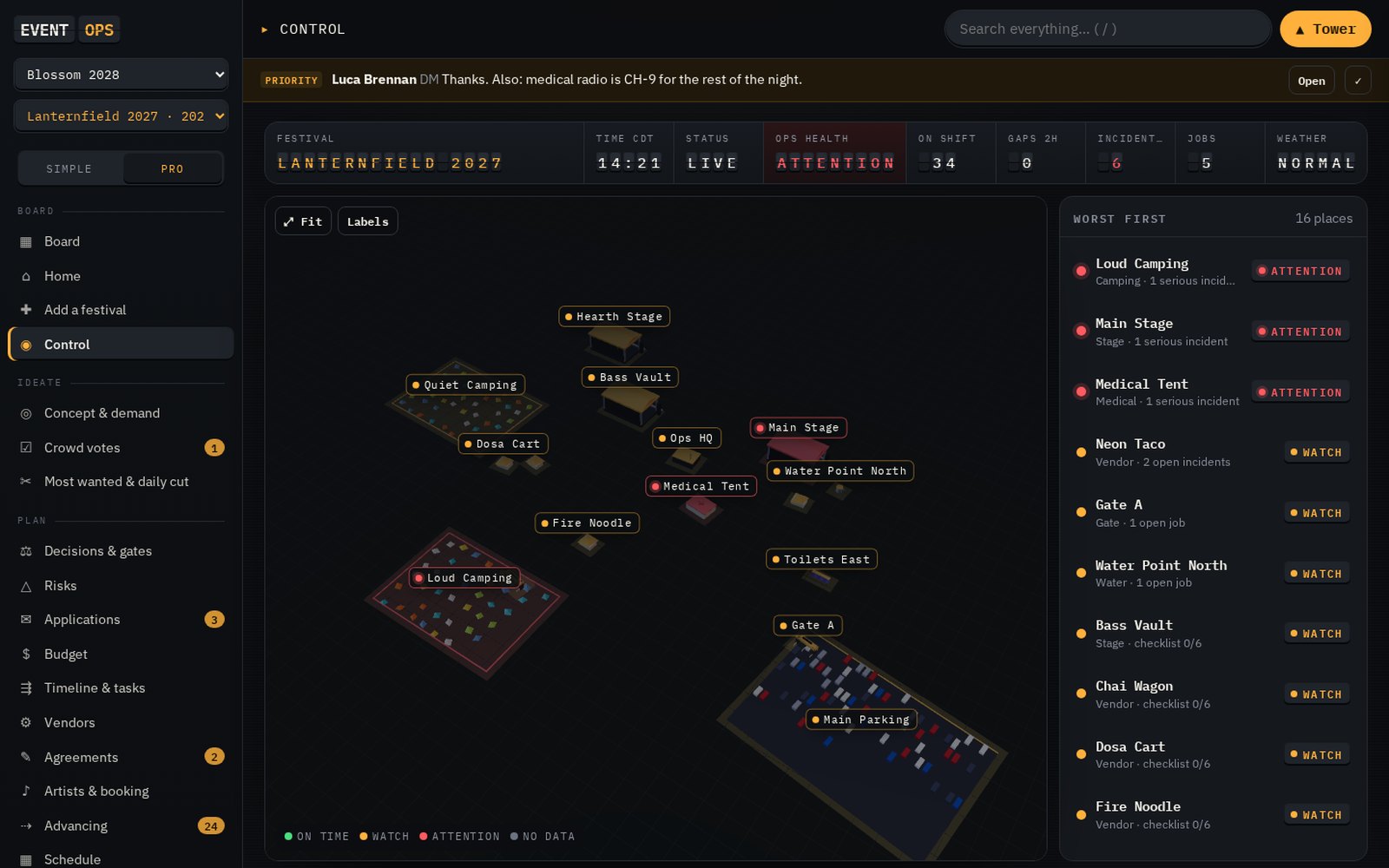
- Client
- Our own product
- Type
- Multi-tenant web platform: public site, organizer app, offline crew app, marketplace
- Stack
- Node/Express + Postgres, plain JavaScript front end, Three.js for the 3D views
- Status
- Live at eventops.si with demo festivals; first real festivals next
- Where
- Built in Greenville, SC for festivals anywhere
The brief
Festivals run on spreadsheets, group chats and a different app for every job: one for the budget, one for the schedule, one for the crew, one for the fans. EventOps puts the whole festival on one record, from the first idea to show day, so the vote becomes a budget line, the budget line becomes a stage and a shift, and the shift shows up on the map when nobody is covering it.
It grew out of our earlier festival platform, whose staff and fan tools were folded in. Because it is our own product, it is also the clearest example of how the studio works: short daily cycles, real screens early, and a design that changes when the people using it say so.
What shipped
- The idea stage: an interest page, crowd votes on the lineup and a go / no-go gate with the numbers set up front
- The plan: deadlines worked back from opening day, a budget that tracks actual spend, permits and agreements, and a next task for every person on the crew
- Show day: a live 3D site map that flags any place with an uncovered shift, incidents and radio in one feed, and a crew app that keeps working with no signal
- A 'throw a festival' wizard that builds a plan, budget, starter map and public page from five answers, with a Simple mode for first-timers and a Pro mode for producers
- A role for every person from the producer to the volunteer at the gate, enforced on the server, and white-label branding per festival
- The Network: a directory where festivals post requests and venues, vendors, artists and crew send quotes
How it was built
A Node and Express backend on Postgres serves a plain JavaScript front end; the control room and the homepage stage are Three.js. Each organizer gets a workspace, and every festival inside it shares one data model and one login.
An AI copilot, Tower, can read the festival record, draft text and suggest next tasks, and every change it makes is logged and can be undone.
Where it stands
- One platform covers the idea, the plan and show day instead of a separate tool for each
- Organizers can see a working festival in about a minute with the wizard, and walk through the demo with a person
- The same building blocks (roles, change log with undo, 3D maps) are available to client builds
One lesson
Model the whole festival as one record before building screens. Once the vote, the budget line, the stage and the shift are the same data, every new screen is a view, not another app.
Want something like this for your business?
We work remotely with clients across the United States and worldwide from our studio in Greenville, SC. One 30-minute call, one fixed price.
Services this proves
More case studies
- Hart of Christmas →
3D storybook website + store + owner dashboard
- Tahoe Engaged →
WordPress rebuild + in-house back office
- Client City →
Walkable 3D town where every house is a client website
- Space Station Plaza →
Community web app with a live calendar engine, member accounts and a walkable 3D station
- Holistic Music Academy →
Membership platform with courses, mentorship, community and split payments