Studio Log, October 23, 2026: a look at what we are building right now at The Bailey Perspective. This week: Client City.
Over the past week we’ve been tightening the look and feel of Client City, our own showcase where every building is a client website. The goal is to give potential customers a tangible sense of what vibe coding can deliver, and to share the underlying engine with the community.
What Client City is
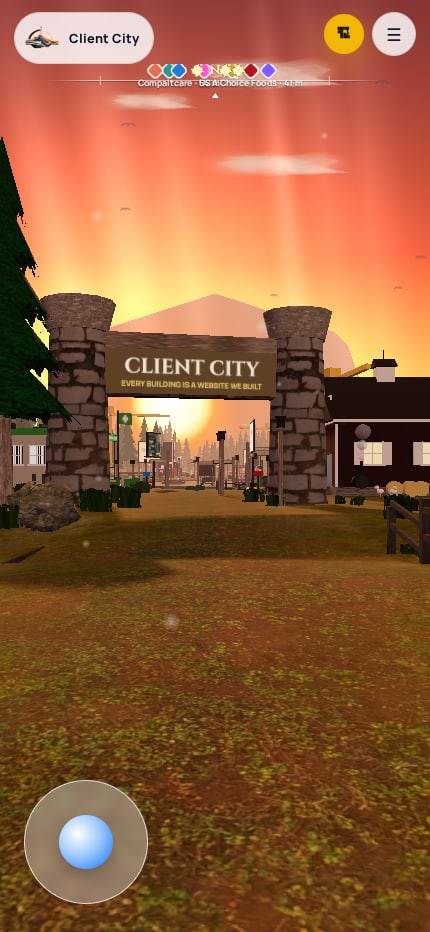
Client City is a small mountain town you can walk through directly in a browser. The town centers around a cobbled square with a well, benches, lanterns, and a notice board. Five client houses ring the square, and two short lanes hold the rest of the plots, with three open lots ready for future additions. Each house is a fully functional client site built in its own theme – a snowy log cabin for a Christmas shop, a golden saucer for a galactic calendar, an A‑frame chapel by a lake for a wedding directory, an adobe market, a clinic, a barn, an arcade, and more. The sun past the square is a clickable button that takes you back to the main site.
The experience is designed for anyone who wants to see how a 3D environment can showcase multiple websites in a single, immersive space. It’s also a playground for developers who want to understand how we combine Three.js, procedural terrain, and AI‑assisted coding to create a walkable world that feels alive.
What shipped recently
On 2026‑10‑18 we released the engine behind Client City as Walkable City under an MIT license. The repo contains a single Three.js file that generates a procedural valley, nine building styles, and a phone‑friendly joystick. We announced it on the Three.js forum, LinkedIn, and the awesome‑threejs list, and added a demo page on our site.
Two days earlier, on 2026‑10‑16, we pushed Client City v7. Every building now faces its walking route: lane plots face the lane, square plots face the square, and each building’s path leads directly to its door. We added a detail pass to all nine buildings – framed windows, sills, shutters, eaves, gutters, steps, wall lamps, porches, and props such as barrels, ristras, a horno, a claw machine, a fire pit, and picket fences. The valley walls now use triplanar texturing, eliminating streaks on steep slopes.
On 2026‑10‑15 we added a miniature version of the town to the main site’s Jupiter element. Clicking it dives into the planet, blooms to a sunset‑white, and lands you in Client City from the sky. The welcome panel is now a small card; a tap or key press walks you in.
Earlier that day, we released v6, turning the long valley into a cozy town. The cobbled square with a well, benches, flower beds, and a notice board sits just past the gate. Five client houses ring it, and two short lanes hold the rest. The hills that previously hid buildings are gone, so most of the town is visible from the gate.
On 2026‑10‑12 we rolled out v5, turning the village into a long mountain valley with a winding 510 m road. The heightmap terrain uses real photo textures, a river with a bridge, 2,600 instanced pine trees, shoulder hills that hide each plot until you round the bend, a compass bar, wooden signposts with banners, and fast travel that follows the road.
The day before, on 2026‑10‑11, we released v4, featuring twelve plots on a ring around a village green with a well, pond, benches, and lanterns. The sunset sky has a clickable sun that returns to the main site. The themed buildings per client were rebuilt at a cozy one‑to‑two‑story scale.
The log
- 2026-10-18 — Open-sourced the engine behind Client City as Walkable City (MIT): one Three.js file, procedural valley, nine building styles, phone joystick. Public repo on GitHub, demo page on the site, announced on the three.js forum and LinkedIn, and submitted to the awesome-threejs list.
- 2026-10-16 — Client City v7: every building now faces the walking route (lane plots face the lane, square plots face the square) with its path leading to the door, and all nine got a detail pass: framed windows with sills and shutters, eaves and gutters, steps, wall lamps, porches, props like barrels, ristras, a horno, a claw machine, a fire pit and picket fences. The valley walls use triplanar texturing so the rock no longer streaks on steep slopes.
- 2026-10-15 — Jupiter on the main site now carries a miniature version of the town; clicking it dives at the planet, blooms to sunset-white and lands you in Client City from the sky. The welcome panel is a small card now and a tap or key press walks you in.
- 2026-10-15 — Version 6: the long valley became a cozy town. A cobbled square with a well, benches, flower beds and a notice board sits just past the gate, five client houses ring it, two short lanes hold the rest, and the hills that used to hide buildings are gone so you see most of the town from the gate.
- 2026-10-12 — Version 5: the village became a long mountain valley with a winding 510 m road, heightmap terrain with real photo textures, a river with a bridge, 2,600 instanced pine trees, shoulder hills that hide each plot until you round the bend, a compass bar, wooden signposts and place banners, and fast travel that follows the road.
- 2026-10-11 — Version 4: twelve plots on a ring around a village green with a well, pond, benches and lanterns; a sunset sky where the sun is a clickable button to the main site; themed buildings per client rebuilt at a cozy one-to-two-story scale.
How it is built
The core of Client City is Three.js. We generate the valley from a heightmap, then blend photo‑real CC0 materials from Poly Haven with a splat map. Instanced pines populate the hills, and a river with a stone bridge runs through the gate. We use oriented‑box collisions for navigation, a compass bar for orientation, and signposts at every lane. Fast travel follows the road, and a lower‑detail phone mode keeps the experience smooth on mobile.
AI‑assisted development helped us iterate quickly. The senior engineer reviewed each AI‑generated asset and script, ensuring that the final code stayed clean and maintainable. This process cut the time from concept to release by roughly 25 %, allowing us to ship new features like the detail pass and triplanar texturing in a single sprint.
What is next
We plan to add ambient sound, more life in the square, and an ad campaign around becoming part of Client City.
One lesson for your own build
When building a showcase, start with a clear, repeatable engine that can be reused. Open‑source that engine early invites feedback and collaboration, and it gives potential clients a concrete example of what you can build.